Sunday, April 14, 2013

120 Hours in Phuket, Thailand


The plane wheels bumped the runway at 2 A.M. The Phuket National Airport reminds me so much of the Delhi bus station. Chaos. Coincidentally, Thais greet each other the same way as Indians, with hands in prayer. "Mai" replaces "Namaste" as the greeting. When I first arrived in Japan seven months ago, I involuntarily reverted back to greeting people this way. It took me a couple of weeks to break the habit and for the traditional Japanese bow to become automatic. The first two days in Thailand I was bowing to everyone. Finally, I got the hand gesture back. When we came home to Japan again five days later, it took a few more days to rid myself of "Mai" hands. It's like jet lag, but with greeting customs.

We paid WAY too much for a cab to our hotel. I blame this on two things: 1. We hadn't properly memorized the dollar/yen/bhat ratios. 2. We were exhausted and had been traveling for about twenty hours total. 5 1/2 of those hours were spent in the worst place on earth. Seriously, there can be no place worse than the Shanghai airport. I imagine it as a lower hell realm. "Restaurants" had the rudest servers, service personnel provided no service, everyone was miserable because they had to wait in the international terminal, separated from the entirety of the airport, and when you looked outside, all that could be seen was endless haze. Seriously, they need to sell highly concentrated doses of vitamin D in that airport. Everyone would benefit, even the natives...especially the natives.

1700 Thai baht, the cost of the 35 minute cab ride from the northern located airport to our west central hotel, is equivalent to $57. No prices in Thailand, a cheap country to travel in as long as you don't let souvenir shops overcharge you, reflect the high cost of living in Japan, but that cab fare sure did. Oh, the "cab" was some regular dudes Honda civic. About every third or fourth roadside store is a stand offering cab rides to the some 6 million tourists who visit Phuket in a year. ALL of them are cheaper than the one we took.

Arrival. Check in. Pass out. Wake up three hours later. I figured sleep could come after a day of exploration. Free breakfast. Naps by the Indian Ocean. Clear water. Beautiful landscapes. Rented jeep dubbed SS DEATH TRAP. Seriously, it was. Shocks didn't exist and the axles were so rusted every turn felt like they were snapping in half. The "meat" of the lime green rental was JEEP, but the steering wheal was Honda. The whole dash had been ripped up and replaced with a thin metal sheet. It had an RPM gauge and speedometer poking through, but they didn't work. The gas gauge supposedly did, but I was skeptical. The floor was covered with mats, but if you moved them over with your foot you could see through to the road below. The bottom part of the back seat was not attached to the metal, so the back seat was really two horizontal metal bars with a back leather cushion that looked like an army of cats had desolated it. John had to keep one foot on the gas and one on the brake to start it. There was an emergency break, which we used, but I don't know if it was any good. I thought I'd be adventurous and get behind the wheel on the wrong side of the road on the wrong side of the car (their roads are like Japan's) but my bravery quickly diminished and I was passenger the whole trip.

Day 1. Skipped the tourist filled beaches in the afternoon and followed the locals inland to Phuket town. It was fun to walk around in this old "downtown" district. John got some great shots of locals and I enjoyed seeing many Buddhist temples, adorned with gold and bright primary colors. Other than people yelling to offer us rides (we exchanged the SS DEATH TRAP for a leisurely stroll), we enjoyed the old shop houses  Sino-Colonial mansions, and local flavors.


Day 2. Beach side. Pool side. Foot massages. The beach side is not only lined with shops and restaurants, but also an alarming number of outdoor massage booths. 1 hour foot and shoulder massages on the beach were about 5 USD. By the time we left, I had 3 massages (the aforementioned, one aloe massage, and one traditional Thai massage) and a pedicure, and I didn't spend more than $35.


Day 3. Sailing trip to Phang Nga bay. Famous for the location of the James Bond flic The Man with the Golden Gun, this island has a lot more to offer than a Hollywood name. We hopped on Captain Mark's Aussie sail boat with an Australian family and a childless older French couple to explore the hidden caves and secret hxng(s) (Thai for room; pronounced hong). In the case of islands, hxngs are inner areas of water not accessible from the perimeter of the island.


At night, we found an Italian shop that sold the freshest produce and comfort foods from home. We bought red-pepper roasted foccacia bread, tomatoes, basil, emmental cheese, fancy shiraz, and baked kettle chips. We went back to the hotel, made sandwiches, and cheered to the love that brought us there.

Day 4. Elephant trekking.  Gibbon Rehabilitation Center. Bang Pae Waterfall located in  northeastern Bang Pae national park. The rainy season hasn't happened in Thailand yet, so the waterfall was devoid of water. However, we still had a nice 30 minute hike to the top, led by the cutest dog affectionately dubbed Sir Shrimp Scamppers the wee wonder mut of Bang Pae. I've now been lucky enough to be led up hilly terrain and Himalayan mountains by the sweetest dogs in both India and Thailand. I left them with pieces of my heart.


Gibbons are apes indigenous to East and Southeastern Asia. They resemble monkeys in appearance and habit  and are known for their speed and distinctive singing. Sadly, the species was wiped out through poaching by the 1980s on Phuket island. Now, they are making a comeback through WARF's Gibbon Rehabilitation Project. I was in tears when I learned about the lives of some of these resilient creatures. There are numerous gibbons being used as tourist attractions on Phuket. By paying to have photos taken with a gibbon, people are helping to reduce the number of wild populations and cause suffering to these animals. Most of the apes at the GRP had horrific backgrounds: being drugged to stay awake, and forced to drink alcohol and smoke cigarettes for tourists' entertainment. We bought t-shirts and donated a huge chunk of money so these sweet creatures may one day make it in their natural homes with their families.


In the evening we drove to a beach about 6 km away and had a yummy buffet-style dinner at a place called Nok and Joe's. This restaurant has a pleasant story. Joe is a Canadian expat who moved to Thailand and met and married Nok. After the 2004 tsunami, Joe built this restaurant entirely out of driftwood (bar, chairs, tables, everything). The atmosphere was uncannily similar to the flora-bama. It was a bit touristy, but quite warm. The couple gave Nok's original seafood restaurant to Nok's sister. The night we went, we enjoyed a Caberet show with Thai ladyboys, hosted by the worst open mic guitar player. As we were leaving, the man started singing "Sweet Home Alabama" and I knew that few things in my life would feel as surreal as that moment. Seriously, dude. We're in freaking Thailand! Before we left, John showed the dude his driver's license, and the singer's reply was, "I don't want your ID, I want your money!" We didn't break it to him that we lived in Japan, with rapidly declining yen.

Day 5.FLYING HANUMAN JUNGLE TOUR! The raddest thing ever. A zip line course through one of the preserved rain forests on Phuket island. 28 lines. Crazy height. Rad views. I was full of adrenaline the entire 2 1/2 hours. The longest ride was 400m with a top speed of 60 km. WOO! Okay, honestly, I was scared poopless, but it was so FUN! Of course, by the time my brain juices settled, the course was over. Next time, I'm hanging upside-down.


During sunset we climbed up giant rocks on the beach's perimeter, and watched how fast the fire retreated to the west. The red-orange plasma reflected on an 18th century-like ship and the blue water. At that moment, anything I imagined was true. The Pacific, Atlantic, and Indian Oceans are now settled in pockets of memory and I'm anticipating all the gorgeous and mundane pleasures of the future.

High tide, in the twinkle of glowing lamps, we walked, toes in the sand, cool water whipping, playing, trying to reach our thighs. Every moment like this is perfection. Whatever beach, any lover's hand, there's something about the water that pulls us to the beginning of time, when we are one with every creature we used to be, and we can hear desire like an ode driving us to evolve into even more greatness.

We noticed a neon- glowing bridge in the water, at the end of the beach, and like bugs to light, we were drawn. The contraption looked like giant legos pieced together to make a 100 yrd. bridge on the water. At the end was a ladder down to a roped off swimming area, deeper into the ocean than I would ever swim. We wobbled to the end, brave, and giggling, and thanks to this wonderful play toy some random children, John, and I can now claim that Jesus was not the only one to walk on water.

Day 6. Lazy day preparing for returning flight.

Phuket's total population is roughly the same as Mobile, AL, however they see 6 million tourists/yr. Surprisingly, since Putin's trip to Phuket a few years ago, a majority of these tourists are Russian. According to The Phuket News, Russian tourists and Chinese visitors accounted for 38% of arrivals to Phuket last year. But a lot of locals and Aussie expats I met don't care for them. The reason according to the aforementioned source: Russians  like exclusive things...and that's the problem- there are no exclusive things in Phuket.

John and I were at a restaurant about 5 minutes from our (almost) beach side hotel (first we had to cross the street and walk through a small field) and the table beside us was a Russian family. We observed them rudely calling servers, walking up to the kitchen area and taking things, and constantly harassing the workers. They had someone at their table about the entire hour they were there, and were requesting outrageous things like (4) boxes of Kleenex and plain white toast. The servers ablidged and smiled, but I could tell they were offended.

It might not be a first world nation, but there are worst fates than residing in exotic Thailand. Our unofficial plan is to get as many people as we know to move with us there and open a make-shift operation providing English lessons, yoga classes, and kayak tours (You know who you are people; you better deliver)! ;-) Our official after-Japan plans are unknown. We still have so many places to travel while we're on this side of the world.


Onward,

Leah

Tuesday, March 5, 2013

Rants, Recollections, and Musings: A Review of Early 2013


Experiences and (Jaded) Commentary

Waiting anxiously in a hospital emergency room not once, but twice in a week does more than make you understand how Spanish-speaking immigrants in America feel. It leaves you feeling beyond helpless, blunderous and exposed in a world that "foreign" does not even begin to describe. Thankfully, my husband's severe stomach pains that led us stumbling into such incompetence were nothing serious. After some painstaking paperwork and tests, as well as sure incomprehension about how Japanese hospitals work, we were sent home (twice) with some medicine and "reassurance" that everything is fine. Really, we weren't feeling so reassured, due to many factors, chief among them: our limited Japanese (fruits and vegetables, colors, and random nouns and verbs do not help you at the hospital), the doctors limited English, and the fact that we went through the same process two times in one week in two different hospitals. We spent way to much money on tests that John's ridiculously expensive insurance should have covered.

But even in shadows, there is proof of light. After some intense reading about John's symptoms and the accuracy of the kind of test he was given, we've finally relaxed and are happy to report that normalcy (or what can be considered so) has returned. And now, of course, we have these lessons if this worst-case-scenario ever pops up again. For example, always ask for test results, as one hospital won't call another to get them, but will make you go through any procedure you've already done. There are certain people (who in all honestly are just trying to help) that you should not tell about hospital visits. These people will proceed to plan any necessary subsequent visits to the places they think best, even if there's a perfectly respectable English-speaking, technologically advanced clinic one hour bus ride away that you can certainly navigate by yourself.

In other news...well, there isn't. We are continuing to labor in our oh-so-unfulfilling "jobs". John's contract at the elementary school an hour and fifteen minutes away ends March 9. After that, I think he'll take some time looking for jobs in our city. It's about time he works closer, so he's not commuting two and a half hours a day. All that train time (see previous entry about Japanese transportation, with an erroneous title about whiskey that is subsequently explained in said entry) seems to be, from what I've read, a direct link to depression. Either he'll find a job he can bike to, or he'll tutor privately. We're both excited about this, because it gives him more time not only to be at home, but to employ himself in activities he actually enjoys. Some things he doesn't enjoy are: the train, inevitably filled with staring (and occasionally yelling) drunkards and sardine-packed-people; two graduate university classes costing upwards of $3000 that employ professors who can't understand English (in a TESL graduate program) and others who use the exact same activities from previous semesters; the two hour ride to said university; cucumbers; and his wife, who feels obligated and grateful to leave her usual bubble of activities, endlessly making social engagements.

Of course there are high points. We've heard from many expats that the six month mark is an unusually tough time of adjustment. Add to that a job where I'm sitting 6-8 hours a day (makes me oddly miss retail and not-so-oddly, movement) and you've got this: a bitter blog entry composed mostly out of a need to keep up with this project after skipping two months and to quell my boredom. (I am currently at previously mentioned desk with no internet and no lessons for today. I am typing in notepad because Word corrects me too much). Even with all this apparent hostility, though, my aim is to say yes to all of the Japanese experience. Though it's misunderstood and frustrating, there are parts that are truly beautiful. One of those is the community center English class I teach on Tuesday nights. That class is full of gengki (roughly translated as fine, enthusiastic, full of life) 50-70 somethings who teach me about Japan/ Japanese culture and speak English as eagerly as a children open birthday presents. As the lingua franca, when these people travel it's all they have. English literally opens worlds for them, and they are so happy and so grateful that I take the time once a week to speak with them and teach them. One woman in her early fifties, Miyahara-san, brings me omiyagi--a souvenir, memento, or keepsake; an object a traveler brings home for the memories associated with it-- every week. I've received books, candies, pictures, pamphlets, food and trinkets from her. She's taken John and I to see shrines in other cities, to Tokyo German town, Yokohama, and other places.
Yokohama:

You can see Fuji San (Mt. Fuji) vaguely in the distance 
Ah Hell Naw!
Foreigners Graveyard 
February 24 she took us to a soba-making class, where we made Japanese noodles from scratch. It was a little frustrating, firstly because John and I both had colds, and were doped on OTC meds. Secondly, because it seems that the Japanese way of teaching goes something like this: show someone how to do something; let them try for about thirty seconds; tell them they're doing it wrong, and in the name of "reshowing", actually just finish said task. I see this everywhere, from mothers talking to children to teachers talking to students. It's amazing anyone learns to do anything...I guess they're practicing alone.

There are a handful of people who shower us with such kindness. If I can't return what they've shown to me, I can pass it on.

Currently, I'm skimming through a interesting book full of commentary about Japanese culture. It's quite an academic read, and after about ten pages I have to put it down in exchange for a novel, newspaper, or the NYT crossword. However, it's teaching me so much about the culture.

"Uchi (inside) and soto (outside) have metaphorical extentions in Japanese like in no other major language. These metaphors have cultural social, and cognitive implications and underlie key concepts of the culture." Some people would say that uchi space is up to one's skin, composed of the brain and other inner workings. But Japanese takes it much farther, so that it can mean one's house or home. A Japanese house is usually surrounded by either brick walls or fences. There is always a gate. Once you enter the gate, you feel the first sense of uchi, being inside the walls. But this is ambivalent, since it's still between the soto and uchi of spaciality. The ambivalence continues in the genkan, where your have to take off your shoes, no option. The genkan might seem like the inside because it is under the roof, but it is lower in height than the entrance, and acts as a sort of holding space before one is invited in. Still, once past the genkan, you are not in uchi, though it may feel so. The layout is designed so that guests are rarely able to access the innermost areas.

Uchi space is not just physical but also social. This space is one of involvement. As with collectives, people rely on expanded rather than individualized ego. There are other key cultural concepts that identify the uchi/soto relationship, respectively:
1. real wishes vs. stated reason
2. humane feeling vs. social obligation

overall, these metahpors (uchi/soto) help to explain  various cultural as well as linguistic phenomena (such as why people never say excuse me in crowded areas: you are outside their uchi space). The distinction between uchi and soto also help one to understand the many different Japanese linguistic forms, which change depending on who you're talking to and where you are. For example, there are four different ways to say what translates as "I understand," depending on if the person you're talking to is a superior, peer, family member, etc.To learn more see "Uchi and Soto as Cultural and Linguistic Metaphors", by Seiivhi Makino, a chapter in the larger collection Exploring Japaneseness: On Japanese Enactments of Culture and Consciousness, ed. Ray T. Donahue, 2002.

There are some examples of this. So far, I've watched two Miyazaki films (Japanese animated movies) that are aesthetically quite beautiful and teach you about Japanese mores the same as fairy tales inform one about American ideals). One is called Spirited Away ( Sen to Chihiro no kamikakushi "The Spiriting Away of Sen (name) and Chihiro (name)" in Japanese). The film tells the story of Chihiro Ogino, a sullen ten-year old girl who, while moving to a new neighborhood, enters an alternate reality inhabited by spirits and monsters. After her parents are transformed into pigs by the witch Yubaba, Chihiro takes a job working in Yubaba's bathhouse to find a way to free herself and her parents and escape to the human world.  Another is called My Neighbor Totoro (pronounced toe-toe-row). It follows the two young daughters of a professor and their interactions with friendly wood spirits in postwar rural Japan. I learned from this movie (and indirectly from a teacher at my school) that children and parents bathe together well into junior high school (Again adding to the sense of home and family as uchi territory) .

There are some 50,000 convenience stores in Japan. These places are surprisingly convenient, unlike anything we'd compare them to in America. You can buy bottled drinks, alcohol, produce, some groceries, ready-to-eat (but fresh daily) food, vitamins, school supplies, some OTC meds, and other things. You can also buy an assortment of magazines, anime and otherwise. On this aisle long rack of printed pages, there are many anime pornos, in plain sight of anyone reaching two-and-a-half feet, featuring big-busted women fingering themselves or tied up and crying.

In Okuizumo, Japan, a replica of Michelangelo's David was installed without much warning last summer. The famously nude biblical hero is raising eyebrows-and reportedly scaring children- in this town in Shimane prefecture. The sixteen-foot-tall statue was donated by a local businessman who hopes the town's residents will learn to appreciate the sculpture. However, the townspeople are calling for underpants.

That's right, underpants.
on a statue.
Of David.

Despite the reputation of some Japanese for- shall we say- esoteric sexual predilections--full frontal nudity is illegal in photos or on film.

Oh, I forgot to mention that the anime women were "wearing" scantily drawn bras.

On the one hand, I am a Westerner (Soto space). Granted, the women are drawn, and parents can keep their children from seeing what's inside. But seriously, aren't drawn pictures of sexually exploited women (uchi,culturally) much more offensive than artistically sculpted penises (soto, culturally). Also, did I mention that not only do parents and children bathe together, but people (men and women separately  often bathe in public bathes together. Kids see "private parts" on a daily basis. Instead of fearing a sculpted member I'm afraid these little boys and girls should fear becoming call girls who stand dressed in school girl outfits to entice men inside, or businessmen who are married to their jobs instead of their wives. Japanese businessmen are required by custom to get so shitfaced with their bosses after work that by the time they realize it, twenty years have passed, their children are grown, and they've never made their wives moan.

I've also noticed that compulsory education in Japan is a lot less about subject matter and a lot more about teaching children "how" to be Japanese. There are countless assemblies with limitless rituals, students stand and sit and move according to custom and always in a group. They're told to work hard and study without actually being taught anything (they're told many things; they're taught nothing, except, by example, to always appear busy and sacrifice oneself for the group). OF course, this group mentality does have some merit. Americans are taught in sports and groups that "there is no I in team," altruism is (usually, omitting Ayn Rand and her sociopathic brain farts erroneously labeled books) celebrated, and we're taught to work together despite our differences. These are lessons, in individualist America, that I think are very important. But here, the worst extremes of "doing as your told" are all summed up in one example.

I was in class with a Japanese English teacher, not teaching, of course, but repeating and murmuring words in "native" tongue, whatever that means, since "native" English varies from Alabama to Boston, Yorkshire, or Sydney. I've decided that my job here is less as a human being and more as a robot. "Greetings children. I am from Alabama. Where are you from? Do you speak English? How do you say __ in Japanese? That's right. In English it's __." sigh. Never am I asked to plan lessons, or talk about how second languages are actually acquired. Mindless repetition is the way in education though, from Tokyo to Montgomery we're wasting malleable gray matter on cramming. Save critical thinking for college, board members say. Fcuk the board members. I know why it's not happening here, but I don't know why American teachers aren't on the goddamn streets taking legislative buildings by storm. When/ if I move back to America I envision myself a radical. I'll picket and protest and rip flags and bare breasts. I'll use all my time to study Spanish and then volunteer at City Hall to help immigrants fill out paperwork. Non-native speakers need friends. Educators needs to burn multiple choice tests. ETS needs to fuck themselves.

In the Japanese class my rant pulled me from, the students were doing a worksheet. At the end of class, the teacher had written on the chalkboard
1.
2.
3.
4.
.
.
.
11.____________________________
12.____________________________

11 and 12 were sentence answers while the others were just words, so they got lines. Students were called on to write the correct answers on the  board. Things were running relatively smoothly (as defined in a classroom at this school) until number 11. A student was called up to write the correct sentence answer. He began to write but there was not enough room on the line. Then, the strangest thing happened. He just stopped. He didn't write beyond the line, or below the line, he just froze, like someone had just asked him to figure out the square root of a decimal in 1 second flat. This fourteen year old adolescent couldn't finish the sentence because the line on the chalkboard wasn't long enough. He didn't want to write outside the line. He couldn't until he was told to do so. So he froze.

This is what memorization and regurgitation is doing to children's brains. They're so concerned with vomiting up the wrong answer, or in this case, "coloring" outside the lines and standing out, that they can't think at all. Of course, we can't blame the students. Thinking has never been modeled for them. The "resolution" came about 90 seconds later when the teacher realized the student was on the verge of a nervous breakdown. Teacher apologized profusely (for not providing the adequate dimensions of what to do/ how to act) and drew the line a little longer. I am continuously stunned at the thought of this episode.

Exploration

We're waiting for the weather to warm a bit so we can continue to explore the Boso peninsula- the southernmost part of Chiba prefecture. We went once, unexpectedly, but an old single-car diesel train all dressed up for the day, and then hiked up dirty hills and slid down frozen-leaved paths.


Recently, however, since it's still winter, we've been exploring the Tokyo city-scape. Saturday, February 23, we went to Roppongi, in Tokyo. Known as a favorite expat watering hole, this town became a hub for westerners after the war, and as a result there are a number of what I'd call titty bars, with big Nigerian men constantly on cell phones try to pull you inside. "Ladies free. Free champagne for ladies!" Mmm, no thanks. I'll stick to the vegetarian restaurants and art museums, thank you. For lunch we went to a chain restaurant called Frijoles; John called it "basically Chipoltes". It's the first burrito I've had in Japan that I didn't make and it was amazing. Veggie burrito with fresh guac and a dos equis; yeah, the rest of the day had to be awesome. Luckily, it was, with the exception of John's credit card getting stuck in an ATM it took thirty minutes to find and an additional forty-five for someone to remove.For dinner we went to Chien-Mai, an all vegetarian Taiwanese restaurant. It was small, as every restaurant in Tokyo is, and the waiter was very gengki. He was a skinny old bald man, full of life and an ear-to-ear smile. He wore a bow tie and spoke fast and sweet. Other than the art, I think he was my favorite experience. We went to a place called Mori Art Museum that was showcasing an artist named Makoto Aida.Controversial and diverse, his art was the perfect commentary on Japan and 21st century society. Graphic, colorful, and raw. The exhibit had everything from school-boyesque sketches to installation pieces. It was exceptional. You should look 'im up.

Being Gone

Back in Alabama friends have had babies, and others are getting married. People have moved, visited, grown, and changed. Life, as always, continues. I've found that a very dependable feature of people who live abroad is hearing them talk not just about their homelands, but about the experience of leaving. One thing that undoubtedly exists between all of us-regardless of the from...to differences- is fear. There is a palpable fear to living in a new country, and though it's more acute in the first months, even year, of your stay, it never completely evaporates as time goes on. It simply changes. We're still in the "How do I make friends, adjust, and master the nuances of language?" phase. Next comes the "What am I missing?" phase, which takes this paragraph round full circle. As we settle in to our new lives, time passes and becomes less a question of how long we've been here and more of how long we've been gone; we'll realize people have grown up, moved, married, they will have become completely different people--and we will too.

It's hard to deny that the act of living in another country , in another language, fundamentally changes you. Different parts of your personality sort of float to the surface, and you take on qualities, mannerisms, and opinions that define the new people around you. And there's nothing wrong with that; it's the reason we left in the first place. I wanted to evolve, to change something, to put myself in an uncomfortable new situation that would force me into a new phase in my life.

Having to start from zero and rebuild everything, having to re-learn how to live and carry out everyday activities like a child, fundamentally alters you. Yes, the country and its people will have their own effect on who you are and what you think, but few things are more profound than just starting over with the basics and relying on yourself (and perhaps your wonderful husband/wife) to build a life again. There is a certain amount of comfort and confidence that you gain with yourself when you go to this new place and start all over again, and a knowledge that-come what may in the rest of your life- you were capable of taking that leap and landing (however hard) at least once.

But there are fears. And yes, life has gone on without you. And the longer you stay the more profound those changes will become. Holidays, birthdays, weddings, births-every event missed is a tick marked on a seemingly endless ream of paper.

I know that after this experience abroad I'll look back and realize that so much has happened in my absence. Who knows how hard it will be to start conversations with people after two years, when I am the outsider to inside jokes.

To live in a new place (no matter how truly frustrating, foreign, and difficult; as an outsider in an isolated place) is a beautiful, thrilling thing, and it can show you that you can be whoever you want - on your own terms. It can give you the gifts of freedom, new beginnings, curiosity, and excitement. But to get on that plane doesn't come without a price (and I don't just mean the $1500 just to get our suitcases and our bodies here). I cannot be in two places at once, and from now on, I will always lay awake on certain nights and think of all the things I'm missing out on back at home.

Wednesday, December 26, 2012

Sprinkled with Holiday Joy, History Lesson

Even though I haven't been completely off work this week, John and I have enjoyed this holiday season. We bought our own Christmas presents this year and said they were from each other, a tradition I'm sure we won't keep, but it worked out better for us this time. Actually, John accompanied me to buy my fancy hand-made watch, and so before buying he said "Hey babe, gimmee some money for your Christmas present." Then, a few days later, I was at work while John took the train to a neighboring town about 15 minutes away and went to a bike shop to buy a folding bike for himself. This will make all of his commutes easier, since he now has a bike he can take on the train and use when he gets off.

John's new Dahon folding bike


handmade bunny watch


And soon, I'll get a yoga bolster as a New Year present to add to my tatami-room make-shift yoga haven complete with travel yoga mat, 2 blocks (squishy foam ones, that shall be traded for wooden, one day), a strap, and two blankets. My mother's infinite wisdom sent me packing with two afghan blankets because we weren't sure if our apartment would be furnished with enough bedding. Those blankets now provide duel services: yoga props by day and covers by night. Japanese houses (even the really expensive ones) don't have central heaters, so we have three electric heaters in our apartment that we rotate throughout areas depending on use.

Christmas Eve we had a wonderful lunch date with an elderly couple in the next town over called Yawata. It's still part of the greater city of Ichihara, like Mobile has many towns or sections (i.e. mid-town, LoDa, WiMo, etc.) Norriko-san and Bumi-san are little firecrackers, and they always want to ensure that the current Ichihara International Asssociation Foreign Language Teacher (IIA FLT) settles into their Japanese life without lonliness. The old FLT, who still lives in Japan, also joined us. Norriko-san cooked a turkey (even though she's only done it a few times, so she was asking John for advice) and John carved it in perfect Christmas tradition. Norriko-san told me that at 70, she's learned a lot about making vegetarian Japanese food for me! I appreciate her going out of her way so much. Norriko used to be a calligraphy and English teacher. Now she spends her time teaching community center calligraphy classes. She speaks very good English, and every time we go to here house, she spends about 10-15 minutes testing the evolution of our Japanese. Her husband, Bumi-san, is a farmer. He loves playing golf (like a majority of the Japanese men I've met) and also Japanese-style "chess", called igo (pronounced ee-go). John tried it after lunch; the rules are simple but it's a difficult strategy game. Two players alternately place black and white playing pieces called "stones" on the vacant intersections (called "points") of a grid of 19x19 lines. The object of the game is to use one's stones to surround a larger total area of the board than the opponent. Once placed on the board, stones may not be moved, but stones are removed from the board if captured. When a game concludes, the controlled points (territory) are counted along with captured stones to determine who has more points. John got his ass kicked, but you know, it was his first time, and Bumi has been playing for like 50 years.

Christmas Eve, we decided not to sit around our apartment. I wanted to take John to Doitsu Mura (German Town) about an hour away to see the "illumination" (Christmas lights). We took the train one station south to Anegasaki, then a cab about 30 minutes to Doitsu Mura. (This is the part where you're super impressed that I can get a cab from one place to another in Japanese. Also, I was impressed that I understood about 35% of what the cabbie was saying. My comprehension and writing are coming along far quicker than my speaking). Doitsu Mura was packed with people on Christmas Eve, but we still had a great time taking pictures and looking at lights. When we wanted to leave, we tried to ask the gate attendant how to get a cab. She called the cab service for us, but said that all the cabs were too busy. There was however, a line for a free bus service to a train station (although it was way further west than we needed to be). The line was two people wide and about 300 yards long. We waited in 0-degree weather for about an hour before we got on the bus to the train station. In the end, it was worth it, though.


Christmas day, I had to go to work in the morning (as I have to every morning this week, from 8-11...well, today it was 8:30-11:30...my bed, it's cozy). Then, we got picked up by two women from the weekly Goi komikan (community center) English class. They took us to the Hilton hotel in Narita, about an hour from our house. Our present from them was a wonderful buffet lunch, complete with dishes from around the world. After lunch, Mineko-san and Tomiko-san took us to Katori Shrine. It's famous for many things, but mostly Goshinboku (The Tree God, or better, Scared Tree). Before you get to the worship hall, on the right side there is this massive cedar tree. It is said to be over 1,000 years old, and is about 7.4 meters around.  We learned the traditional way to wash our hands and mouth before entering the shrine. For New Years, there is a giant ring set up at the entrance, a symbol for...well entering the new year. First you walk around the left side of the ring, then the right, and then through. We threw small offerings (100 Y each, about $1.20) into a large wooden box on legs. It also had wooden bars vertically across the top, spaced out about every two inches. Then, we bowed twice, clapped twice, and then bowed again. On New Years day, we'll go to a small local shrine in Goi called Ohmiya shrine to celebrate the New Year in Japanese style. Now we know all the right moves!


Entrance to Katori Shrine

1,000 year old tree

It's extremely difficult to tell the difference between a shrine and a temple. Although there are some differences, like the smoking barrel at temples and the purifying water at shrines, they can look pretty similar and even be built next to each other! The quick and easy explanation is that a temple is a place for Buddhist worship and a shrine is a place for Shinto (Japanese indigineous "religion") worship. So really, the question is similar to asking the difference between a church and a mosque. But at second glance, the simple answer is not so simple, with some historical complications that explain the ambiguities of the differences. Shinto is a religion of nature worship, and originally, people prayed to great natural phenomena, such as mountains and trees. As Buddhism made its way to Japan in the 6th century, it was not met without resistance and in need of an effective marketing strategy. In order to appease the nationalist resistance to a foreign "god" and to help spread Buddhism throughout the country, Buddhism was essentially superimposed onto Shinto, basically saying, "You know, actually, the Shinto gods are Buddhas that are taking another form." This Shinto-Buddhism hybird world continued until the Meiji period when the government demanded the separation of Shintoism and Buddhism in order to restore the legitimacy and power of the emperor, who is regarded as the supreme being in Shinto. Still, hints of a hybrid history remain, as you may see some Shinto objects in Buddhist temples or vice versa, and many shrines and temples remain friendly neighbors.


After we visited Katori shrine, we  enjoyed a  popular snack food for visitors. It's called dango and can be purchased from several shops along the road leading up to the shrine. We also had a popular drink called amazake. We really enjoyed these traditional Japanese foods; I'm sure we'll be eating much more of them!

Christmas night, John stayed home tucked in warmth, and I went with my new yoga buddy to a Christmas night hot flow class. Full of sweat and vinyasas, it was the perfect way to conclude Christmas. It feels so good to sweat when the weather doesn't get over 15 degrees, and is usually closer to 3 or 4 degrees. For the next 10 days, the temperature will be in the single digits, with wind chill in the negative. In other words, it's freaking cold, and I don't like it, so a heated sweaty yoga class was wonderful.

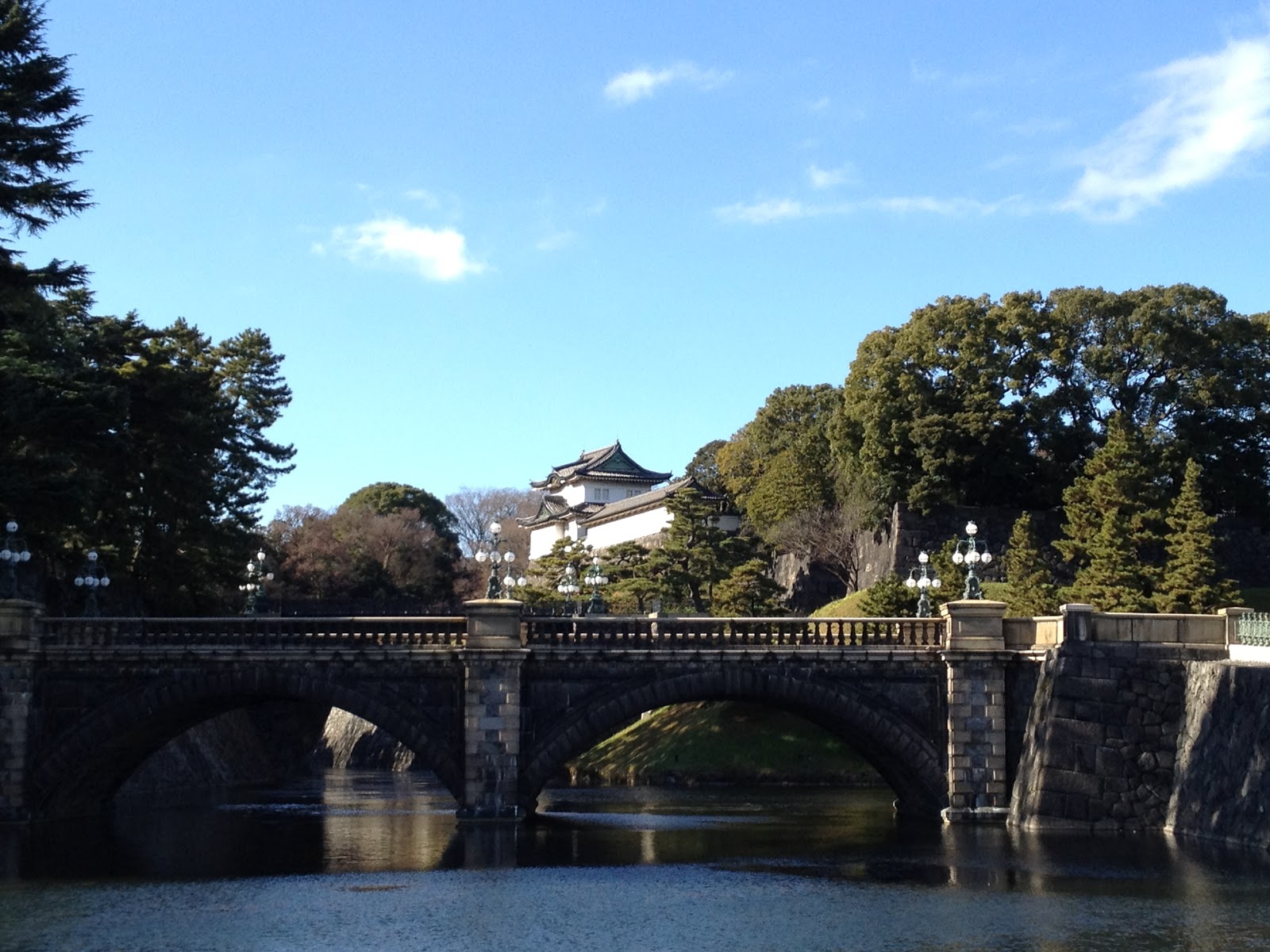
The day after Christmas, I worked in the morning. When I got home, John and I decided to see the Imperial Palace East Gardens, so we hopped on the Rapid train (and switched to a local subway) and we were in Tokyo 50 minutes later. Even though it's winter and there weren't any flowers blooming (except camellias, those resilient things), it was still so beautiful.  They even have a bamboo garden with some 20 different kinds of bamboo!


After the Japanese garden, we decided to check out the Shimokitazawa area. It was about a twenty minute subway ride from the Imperial palace ruins. "Shimokita", as it's known by residents and those "in the know", is considered to be one of Tokyo's hippest neighborhoods, full of cafes, theatres, and music venues. It's laid back vibes and retro shops made John and I realize that we'd moved to the wrong part of Japan! We ate at a vegan restaurant called &Vege hidden behind Starbucks. The online directions read thusly:
- Go into the alley, right side of starbucks.
- End of alley, looking out into the main street.
- Go through the door to the left.
- Go out another door.
- Another alley, leading to the cafe entrance.

It's tiny, even by Japanese standards, with only 10 seats. But the cozy, non-smoking environment and the fulfilling vegan food, both hard to come by in Tokyo, will lure me back. The falefel lunch plate comes with a satisfying mound of fresh salad, freshly fried chipea nuggets, 2 half pieces of pita bread, and one small scoop of hummus, and another small scoop of vegan chili. Even John enjoyed the meatless meal. Sometimes falefel is heavy and greasy, but this was light and tasty, not leaving me grody-feeling afterward. John said after lunch, "If you told me we'd be eating vegan chili today, I'd assume I'd be making vegan chili." What a great surprise!
Also, we found this place!


We made it home by 7:00, with plenty of time for exercise, cleaning, dinner, and THE DR. WHO CHRISTMAS SPECIAL! I enjoyed it with my husband and a small glass of Japanese liquor that he MADE! He took shochu (a Japanese liquor) and soaked kaki (persimmons) in it for about a week. Then, he made a persimmon flavored simple syrup with cinnamon and ginger, strained the syrup, added then added a little more shochu for the perfect Japanese Christmas drink! We gave small bottles to all of our acquaintances for Christmas, combining Japanese ingredients with a favorite Japanese past-time...drinking! It's been a hit so far. Today and Friday, we won't do much but relax, clean, and work out. Saturday, I'll go to a yoga event where we'll do 108 sun salutations. 108 is an auspicious number in India, as well as in China and Japan, but for different reasons. Other than being a mathematically abundant, semiperfect, tetranacci, hyperfactorial, and refactorable number, in some schools of Buddhism, it is believed that there are 108 defilements. In Japan, at midnight on the first of the year, a bell is chimed 108 times in Buddhist temples to finish the old year and welcome the new one. Each ring represents one of 108 earthly temptations a person must overcome to achieve nirvana. For more information about 108,  click here and here.

On Saturday, December 30, John and I are planning to go to Ueno in Tokyo. It's home to a science museum and a big zoo, both of which we plan to visit. On New Years Day (shougatsu), we'll go to Ohmiya shrine in the morning, to celebrate new years, and we'll make some traditional Japanese New Year food (osechi) together, most likely seki-han and mochi. January second, we're going to a famous Buddhist temple in Narita, called Narita-san, to participate in New Years customs.  Then, we'll have a meal with my yoga teacher and her family. My yoga teacher (Mina-san)'s daughter is my age, and she studied ballet in England. Mina, her daughter Akari, and her husband Michi, all speak good English, and I'm so grateful they've invited us to join their New Year activities. We'll be sure to take some kaki-shochu for them to enjoy :-) On the third, we've been invited to another New Year party by a new student in my community center English class. On January 6 I'll wear a kimono to IIA's New Year Party, and on the 7th, I'll return to regular work-days and classes with students. (Although John and I both took off January 8th for the National Championship game, Roll Tide). It's a busy holiday season, full of wonder and festivities. But fancy food, presents, and parties aside, I'm just so grateful to fellowship with nice people and to spend this holiday with my wonderful new husband. 2012 brought my first (two) "real" job(s) using my degree, travels to India, and elopement, leading my partner-in-crime and me to the most foreign of places and richest experiences. I'm hopeful that 2013 will bring just as much excitement and love.

Happy Hols to you and yours.
Onward,
Leah